Input Processing#
The SparseCore accepts sparse inputs (ragged/list of list) packed into a
COO format
(see below). To convert sparse inputs into this format we provide the
preprocess_sparse_dense_matmul_input() API.
This function also returns the input statistics to tune FDO.
This preprocessed input can be directly fed to the tpu_sparse_dense_matmul()
and tpu_sparse_dense_matmul_grad() functions.
Warning
JIT-ing this function with jax.jit() does not work.
Note
The resultant preprocess input arrays are instances of numpy.ndarray().
If you have an input that looks similar to
tf.SparseTensor
you can use preprocess_sparse_dense_matmul_input_from_sparse_tensor().
Internals#
Preprocessed Input format#
Each SparseCore has its own preprocessed input buffer, all of which are concatenated for a given device. Each SparseCore has a list of embedding IDs that require lookup on another SparseCore based on the sharding of embedding table. This requires a partitioning of these IDs into partitions for each SparseCore being queried. The buffer for each SparseCore looks something like this:
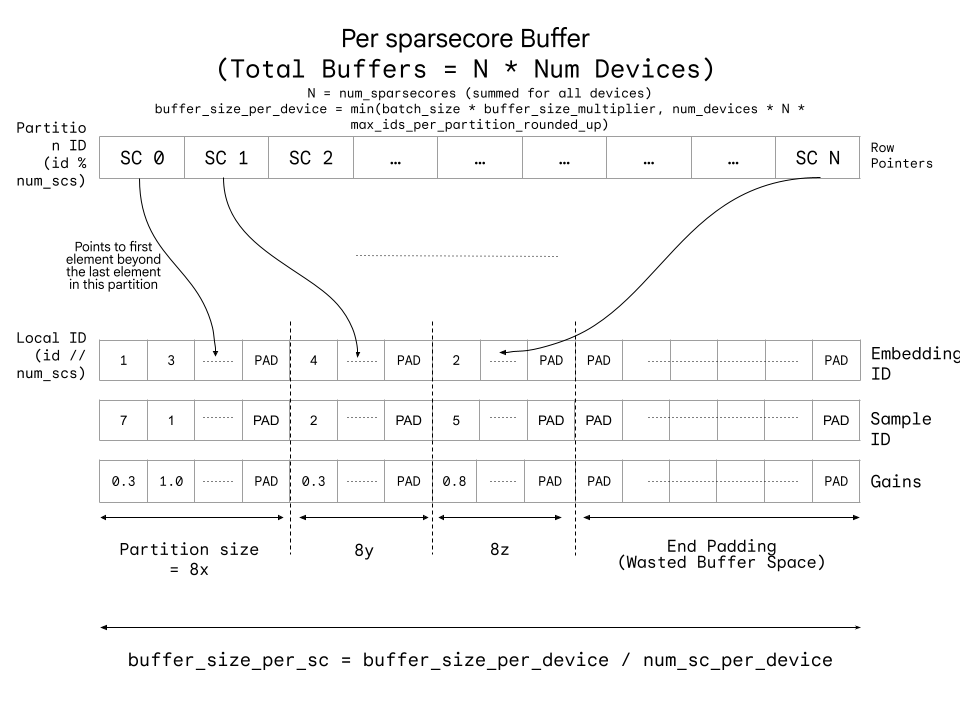
CSR Wrapped COO Buffer per SparseCore#
The row pointers point to the end of the partition for each partition (rounded to a multiple of 8).
The (local) embedding ID are with respect to the queried SparseCore.
The gains are the weights for the combiner.
The sample IDs are used to unflatten the list of samples and reconstruct the activations and gradients.
Some of the partitions may be empty leading to the wasted buffer space at the end.
To optimize for memory, it is thus important to utilize the
suggested_coo_buffer_size_per_device FDO parameter.
Algorithm#
The preprocessing algorithm groups the input embedding IDs by the target SparseCore (based on table sharding) and prepares them for hardware access. Here is a simplified pseudocode illustrating the core steps:
def preprocess_for_sparse_core(features, weights, num_sparse_cores, num_sc_per_device):
  # partitions: (local_sc, global_sc) -> dict of {(local_embedding_id, local_row_id): accumulated_weight}
  partitions = collections.defaultdict(lambda: collections.defaultdict(float))

  samples_per_sc = len(features) // num_sc_per_device

  # 1. Partition & De-duplicate
  for sample_id, (sample_features, sample_weights) in enumerate(
      zip(features, weights)
  ):
    # Data parallelism: assign samples to local SparseCores
    local_sc_id = sample_id // samples_per_sc
    local_row_id = sample_id % samples_per_sc

    for embedding_id, weight in zip(sample_features, sample_weights):
      # Model parallelism (sharding): find which SC holds this embedding ID
      global_sc_id = embedding_id % num_sparse_cores
      local_embedding_id = embedding_id // num_sparse_cores

      key = (local_sc_id, global_sc_id)

      # Accumulate weights (gains) for duplicate lookups in the same sample
      partitions[key][(local_embedding_id, local_row_id)] += weight

  # 2. Sort: Each partition must be sorted by embedding ID and sample ID
  sorted_partitions = {
      key: sorted(data.items()) for key, data in partitions.items()
  }

  # 3. Pack: Flatten and align partitions into CSR-wrapped COO buffers
  return pack_to_csr_buffers(sorted_partitions)